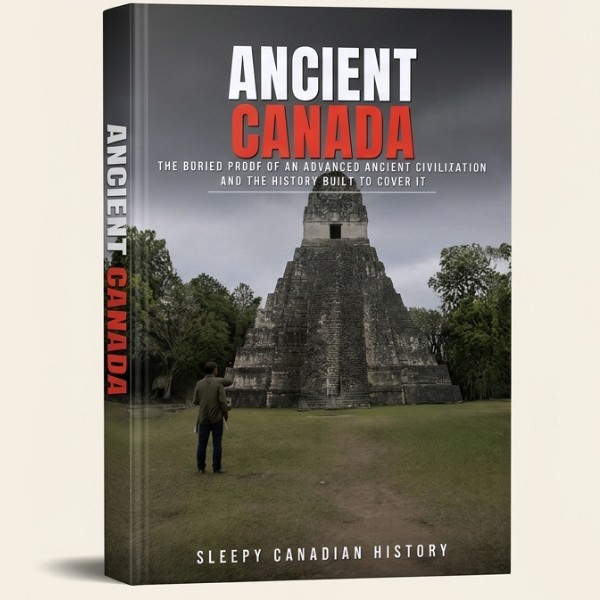
Ten thousand wooden stakes driven into a narrows in central Ontario, still there after five thousand years. Stone walls under the British Columbia tideline, built to farm shellfish, still working. None of it is secret and you can drive to most of it, yet almost none of it made it into the history you were taught. This illustrated guide puts it back.
“I've crossed the bridge at Atherley Narrows my whole life and had no idea what was under it. The chapter on the weirs sent me to the plaque the next weekend. Five thousand years, twenty minutes from my house.”
Derek M.38, Orillia, Ontario
“I've taken the grandkids to Head-Smashed-In three times. After reading chapter nine I finally understood the drive lanes up top. Fifty-seven centuries without wiping out the herd. That is not what we were taught.”

Linda P.56, Lethbridge, Alberta
“The stone walls under the tide chapter floored me. I kayak around Quadra Island every summer and never knew those rock lines were built gardens. Part Six made me angry in the best way.”

Kayla B.27, Campbell River, British Columbia
The version of Canada most of us were handed begins with ships. Before that, the story says, there was wilderness: forest, rock, a few scattered camps, and nothing that would count as history.
That story was never true, and the evidence against it was never hidden. It was filed somewhere you were not going to look, described in language that made it sound small, and left out of the textbook to make room for the fur trade.
The wilderness they described had been somebody's home for eleven thousand years. They simply arrived late enough to miss it.
This isn't a conspiracy of men in a back room. It's something slower and more effective: a story about this continent that was put together for a purpose, taught for a century and never formally retracted. A continent that's empty can be claimed. One that's occupied has to be negotiated for.
This book goes through what's actually in the ground, with the place, the date and how the date was worked out, and then shows how each piece came to be left out.
| Viral videos | School textbooks | This book | |
|---|---|---|---|
| Before 1600 | A “lost civilization” with no name | “Wilderness” and a few camps | 11,000 years of named peoples, dated sites and places you can visit |
| Engineering | Giants and aliens | Canoes and tipis | Fish weirs, clam gardens, drive lanes, palisaded towns, copper working |
| Dates | “Older than anyone admits” | Rarely given | Every date comes with the method used to get it |
| The cover-up | A secret society | Not discussed | Terra nullius, the Mound Builder myth, salvage digs, paved sites |
| Can you check it? | No | Not really | A gazetteer of locations and ages, plus Further Reading |
| Time to read | Endless scrolling | A semester | 42 short chapters you can read in any order |
Seven parts and forty-two chapters, from the story you were given to what's still down there. Here's a selection from the real table of contents.
Chapters 1–6 · how an occupied continent was taught as empty
Chapters 7–14 · structures still standing, still working
Chapters 15–21 · metallurgy, agronomy, astronomy, medicine
Chapters 22–26 · towns, confederacies and the real population
Chapters 27–31 · the collapse that came before the settlers
Chapters 32–39 · how the record was buried a second time
Chapters 40–42 · the surveys, the technology and your own backyard
This book comes from Sleepy Canadian History, made for people who suspect the version of this country they learned in school left out most of the story.
Every chapter follows the same shape. It opens with what you were told, lays out what's actually in the ground, explains what the site required of the people who built it, and closes with how it came to be left out.
Where a people named themselves, the book uses that name: Wendat rather than Huron, Haudenosaunee rather than Iroquois. Where scholarly estimates differ, it gives ranges rather than single figures, and sources are listed in Further Reading.
No. The builders weren't mysterious and they didn't vanish. This book names them. The Afterword explains why the “unknown civilization” version is less interesting and has a troubling history of its own. What's hidden here isn't a vault. It's a record that was left out of the story on purpose.
A video gives you one site and a claim. The book gives you the place, the date, how that date was reached, what the site took to build and how it dropped out of the history books, across 42 chapters with a gazetteer you can use to find each one.
We want this to be the book people pick up first, and a low price helps. This is the launch price and it may change later.
It's an illustrated 134-page PDF. When you finish checkout on Gumroad, the download is ready straight away and a copy is emailed to you. It works on any phone, tablet, computer or e-reader that opens PDFs, and it's yours to keep.
No. The chapters are short and each one stands on its own. Start with the weirs, the clam gardens or the sites that were paved, whichever caught your eye.
Many of them, yes. Head-Smashed-In has an interpretive centre and the Mnjikaning weirs are a National Historic Site. Others are on private land or within First Nations territory and aren't open to casual visitors. The gazetteer notes which is which, and nothing in the book is an invitation to dig or collect.
42 short chapters, 7 parts and a gazetteer so you can go and see it for yourself.
Get Ancient Canada — $14.99
134 illustrated pages and 42 chapters on what's still in the ground across Canada. The launch price ends when the timer runs out.
Get Ancient Canada — $14.99